
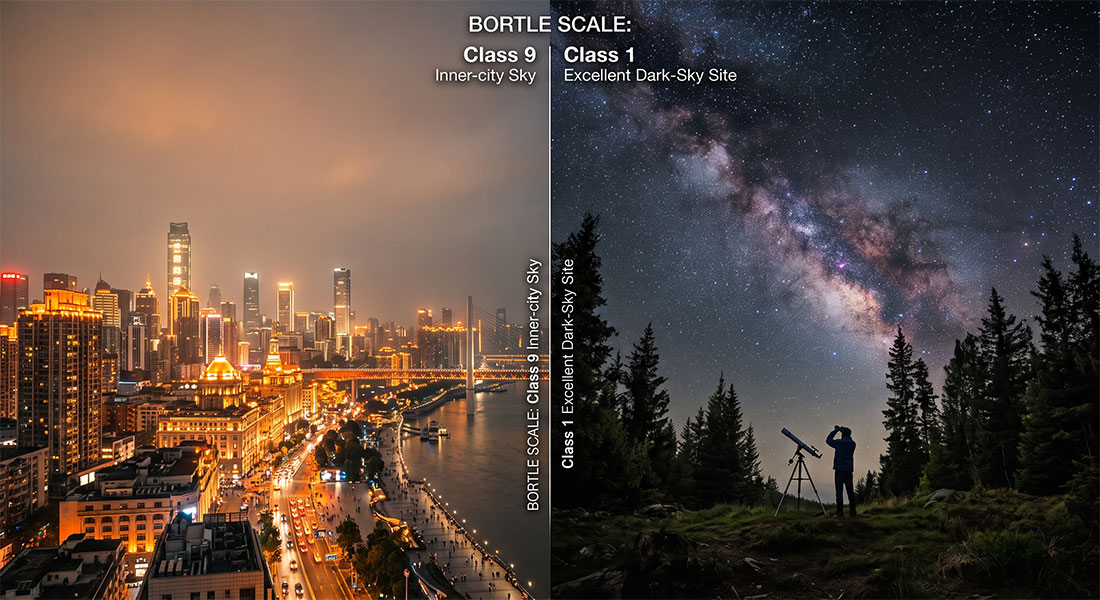
Have you ever driven hours into the countryside, looked up, and wondered if you were truly experiencing a pristine night sky? To the untrained eye, any sky away from city streetlights feels “dark.” However, astronomers use a precise, standardized tool to evaluate the quality of the darkness overhead: The Bortle Scale.
Understanding this scale is the difference between casually spotting a few stars and witnessing the highly structured, three-dimensional core of our home galaxy.
Quick Summary: What is the Bortle Scale?
The Bortle Scale is a 9-class numeric scale that measures the night sky’s brightness and light pollution at any given location. Class 1 represents an untouched, pristine dark sky where the Milky Way casts visible shadows, while Class 9 represents an inner-city sky where only the Moon and the brightest planets are visible. For optimal Milky Way viewing and astrophotography, you should aim for a location rated Class 4 or lower.
What is the History of the Bortle Scale?
What is the origin of the Bortle Scale?
The Bortle Scale was created in 2001 by amateur astronomer John E. Bortle and published in Sky & Telescope magazine to standardize how stargazers evaluate light pollution. Prior to its creation, astronomers relied solely on “Naked Eye Limiting Magnitude” (NELM), which was highly subjective and varied based on an individual’s eyesight.
According to data compiled by DarkSky International (formerly the International Dark-Sky Association), over 80% of North Americans and 60% of Europeans now live under skies impacted by artificial light. The Bortle Scale provides a uniform, objective framework to help the global astronomy community locate and protect the planet’s remaining dark skies.
The 9 Classes of the Bortle Scale
How do you read the Bortle Scale?
The scale is divided into nine distinct classes. As the number increases, light pollution worsens, and celestial details disappear.
| Bortle Class | Sky Quality Description | Naked-Eye Milky Way Visibility | Limiting Magnitude (NELM) | Typical Location |
| Class 1 | Excellent Dark Sky | Highly structured; casts shadows on the ground | 7.6 to 8.0 | Remote deserts, open oceans |
| Class 2 | Truly Dark Sky | Highly detailed with intricate dark nebulae | 7.1 to 7.5 | National Parks, high altitudes |
| Class 3 | Rural Sky | Visible, but lacks complex structure at the horizon | 6.6 to 7.0 | Farmland, remote mountain valleys |
| Class 4 | Rural/Suburban Transition | Visible high overhead; washed out near horizons | 6.1 to 6.5 | Edge of outer suburbs, small towns |
| Class 5 | Suburban Sky | Barely visible as a faint, weak band of light | 5.6 to 6.0 | Mid-sized residential suburbs |
| Class 6 | Bright Suburban Sky | Invisible, or only visible on exceptionally dry nights | 5.1 to 5.5 | Large suburban towns |
| Class 7 | Suburban/Urban Transition | Completely invisible; sky has a grey-white glow | 4.6 to 5.0 | City outskirts |
| Class 8 | City Sky | Completely invisible; only major stars are visible | 4.1 to 4.5 | Moderate city centers |
| Class 9 | Inner-City Sky | Completely invisible; sky glow washes out the heavens | < 4.0 | Major metropolitan downtowns |
How to Measure Your Sky Class Without Equipment
How do you identify your Bortle Class with the naked eye?
You do not need an expensive Sky Quality Meter (SQM) to determine your local light pollution levels. During our team’s field tests in the Alabama Hills, California (a renowned Bortle Class 2 location), we utilized a simple, naked-eye technique called target verification:
-
Let Your Eyes Adapt: Turn off all flashlights and smartphones. Allow your eyes 25 to 30 minutes in total darkness to chemically adapt and dilate.
-
Find the Andromeda Galaxy (M31): Locate the Andromeda Galaxy in the autumn sky.
-
If M31 is easily visible with the naked eye and appears highly elongated, you are in a Class 2 or Class 1 environment.
-
If M31 is only visible using averted vision (looking slightly to the side of it), you are likely in a Class 4 environment.
-
If you cannot spot M31 without binoculars, you are in a Class 5 environment or worse.
-
The Best Tools for Mapping Light Pollution
What are the top tools to find low Bortle locations?
When planning a trip to view the Milky Way, choosing the right planning tool is essential. Here is an impartial review of the top three platforms used by stargazers today:
YouCanSeeTheMilkyWay Live Tracker (Best for Beginners): Our integrated tracker combines real-time cloud cover, moon phases, and local Bortle ratings into a single, mobile-friendly interface. While it does not offer the advanced meteorological datasets of ClearSkyCharts, it is the most intuitive option for planning a weekend trip.
Common Questions About the Bortle Scale
Can you see the Milky Way in a Bortle Class 4 sky?
Yes, the Milky Way is visible to the naked eye in a Bortle Class 4 sky, but its structure will appear faint. The bright galactic core will be visible when positioned high overhead, but artificial sky glow near the horizon will wash out the lower portions of the band.
Do I need a telescope to enjoy a Bortle Class 3 location?
No, you do not need a telescope. In a Bortle Class 3 sky, the Milky Way’s dust lanes and bright star clouds are vividly detailed to the naked eye. A simple, budget-friendly pair of 10×50 binoculars is highly recommended to reveal deep-sky treasures like the Lagoon Nebula and star clusters.
How to Get Involved in Dark Sky Preservation
If you want to verify your local sky conditions and contribute to global preservation efforts, look at the community datasets on the r/astrophotography or r/stargazing subreddits. Users frequently share verified Bortle ratings and coordinates for remote camping spots. You can also participate in citizen science campaigns like Globe at Night, which allows you to submit your own naked-eye sky observations to help scientists map the growth of light pollution worldwide.