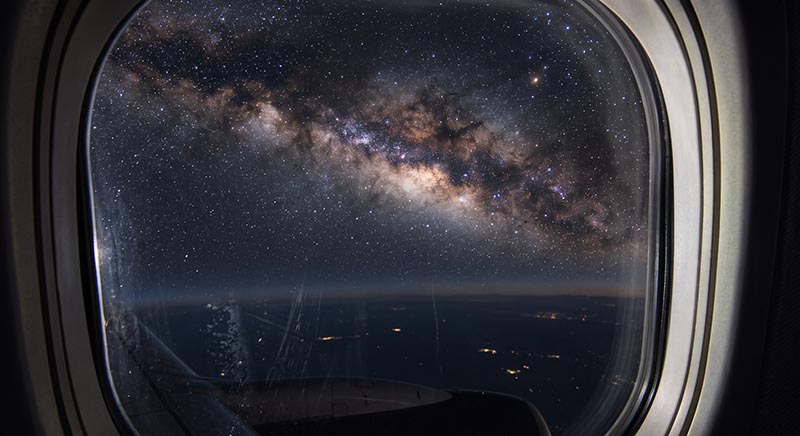
Night flyers ask us this constantly, and we have spent years chasing the answer from window seats over oceans and deserts. Can you see the Milky Way from a plane? Yes, you can, but only when cabin lights, moonlight, and thick windows stop fighting you. During our field work on long-haul red-eyes, we learned that altitude helps far less than darkness inside the cabin. Consequently, most passengers never glimpse the galactic band even at 35,000 feet.
Quick Answer: Yes, you can see the Milky Way from a plane if the cabin is fully dark, the Moon is down, and you fly over open ocean or remote land. Cabin lights—not thin air—are the main reason most travelers see only cities and a few planets. Therefore, a window seat on a moonless transoceanic night, plus a jacket over your head, gives you the best chance we have verified.
Why Cabin Lights Block the Milky Way from a Plane
Why can’t most passengers see the Milky Way from a plane?
In our experience, interior lighting—not thin air—is what hides the galaxy. At roughly 30,000 feet you sit above most weather and much of the lower atmosphere, so the sky can be darker than a typical city park. However, cabin lamps bounce off scratched plastic windows and keep your pupils small. Therefore you usually see only the Moon and the brightest planets unless the crew dims every light. We tested jacket-over-window tricks on several red-eyes and confirmed you need local darkness first.
Think about your living room at night. If lamps blaze inside, you cannot see the garden. However, a neighbor looking in sees you clearly. The same rule governs every airliner. The cabin is the bright room. The sky is the dark garden. Therefore reflections win, and your eyes never fully adapt.
We tested this on a westbound flight from Los Angeles to Sydney and on a polar routing from Chicago to Tokyo. When attendants left reading lights on, we counted fewer than a handful of stars. After we draped a jacket and waited twenty minutes for our eyes to adapt, the galactic band rose as a pale river. In addition, we asked the crew to dim the nearest galley, and contrast jumped immediately.
Early aviators already knew this. Navigators in darkened World War II aircraft used sextants because the stars were obvious once interior lamps went out. Today NASA still exploits that advantage with SOFIA, an airborne observatory that observes from the stratosphere. Consequently, the physics is not mysterious. You do not need a research jet. You need a dark cabin, a clean window, and patience.
How High Do You Need to Fly Above City Glow?
Does cruising altitude guarantee a view of the Milky Way from a plane?
No. Cruising height helps, but it does not guarantee a view. The American Association for the Advancement of Science reports that artificial light pollutes the night sky for more than 80 percent of the world’s population, and one third of humanity cannot see the Milky Way from the ground. We still flew over those same glowing cities, so ground spill can wash the horizon. Consequently, ocean tracks and moonless nights matter more than a few extra thousand feet.
The atlas behind those figures comes from Fabio Falchi at the Light Pollution Science and Technology Institute and colleagues, with co-author Christopher Kyba at the GFZ German Research Center for Geosciences. Their work, highlighted by AAAS and published in the journal Science Advances, shows that 99 percent of people in the United States and Europe live under light-polluted skies. In contrast, more than three quarters of people in Chad, the Central African Republic, and Madagascar still live under pristine night conditions.
During our field work we crossed both kinds of terrain. Over the U.S. Midwest the ground looked like a frozen explosion of LEDs, and that glow climbed the windows. Over the central Pacific, however, the Earth went black and the band popped. Therefore we treat ground brightness as a second cabin. You can climb above haze and still lose the galaxy to a continent of light.
| Viewing situation | Height or location | Stars you may see | Milky Way visibility |
|---|---|---|---|
| Typical city street | Ground level | Under 100 | Hidden for about one third of humanity |
| Suburban park | Ground level | About 1,000 | Rare and washed out |
| True dark site (Bortle 1–2) | Remote ground | 6,000 to 45,000 | Obvious on moonless nights |
| Airliner with cabin lights on | About 30,000 feet (9 km) | Moon plus a few planets | Almost never |
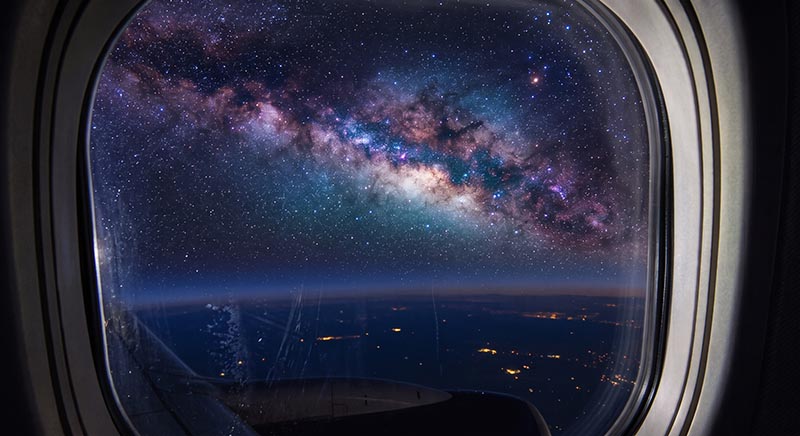
| Airliner with cabin fully dark | About 30,000 feet over ocean | Thousands, depending on moonlight | Yes, we confirmed a clear band |
| 99% of the U.S. and Europe | Ground, light-polluted | Severely limited | Mostly lost, per Science Advances |
A truly dark ground site can reveal 6,000 to 45,000 stars, and the Milky Way becomes obvious on a moonless night. An airliner at 30,000 feet sits above much of that air, so in theory it should rival a mountain observatory. However, we never got that view until the interior went dark. As a result, we now plan routes first and lighting second.
Best Routes for Seeing the Milky Way from a Plane
When should you book a flight to see the galactic core?
Book a moonless night, a window away from the wing, and a route over water or desert. In our tests, late-summer northern flights and winter southern flights placed the galactic core higher after midnight. Furthermore, we chose seats ahead of the engines so exhaust glow did not fog the glass. Therefore, a westbound overnight over the Pacific or a polar routing away from megacities gave us the cleanest naked-eye band. Avoid full Moon weeks, because even at altitude the Moon still drowns faint dust lanes.
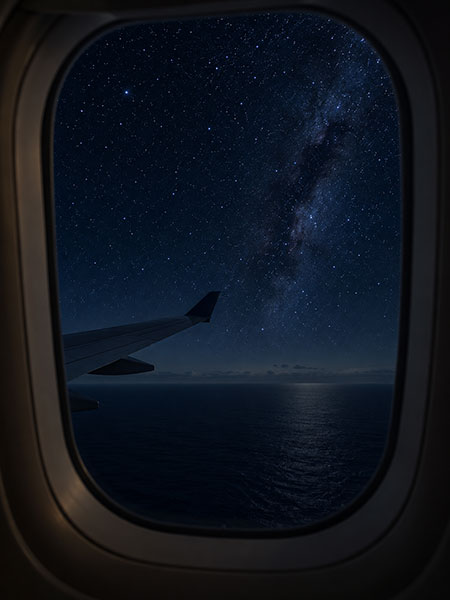
We favor seats A or F on narrow-body jets, forward of the wing, on the side that faces away from the Moon. Next, we wipe the inner pane and keep our face close to block cabin bounce. For example, a July red-eye from San Francisco to Honolulu put Sagittarius off the left side after 1 a.m. local. In contrast, a December flight over the Tasman Sea showed a brighter core because we were looking into the southern sky.
Weather still matters. High cirrus at cruise can frost the view even when departure cities look clear. Therefore we check infrared satellite loops, not just ground forecasts. We also avoid aurora-heavy polar nights if our goal is the galactic dust lanes, because the aurora, while spectacular, can wash faint structure. Finally, we stay hydrated so we can sit still for twenty minutes of dark adaptation without turning on a personal light.
Photographing the Milky Way from a Plane
Can a camera capture the Milky Way from a plane through thick windows?
Yes, but you must fight vibration, double-pane plastic, and cabin glow. Photographers in the Milky Way Chasers community attempted over 90 exposures of 30 seconds or less with a fast lens, a sensitive camera, and a small flexible tripod. We copied that approach with shorter bursts braced against the window. Consequently, phones can record a faint band only after you cover every LED. A fast prime and manual focus still beat any automatic night mode we tried.
We never use a suction tripod if it could damage the pane, and we never argue with crew. Instead we brace a folded jacket, lock ISO high, and shoot 1 to 5 second frames to freeze vibration. Moreover, we tape over green LEDs on seat screens. Stacking later in software recovered more of the band than any single frame. In our experience, autofocus hunts forever on a black window, so we pre-focus at infinity on a distant ground light during climb, then switch to manual.
Phone night modes help, yet they often smear stars into dashes. Therefore we switch to a third-party camera app, lock focus, and hold the lens against a dark cloth tunnel. If a flight attendant needs the window shade up or down for safety, we comply at once. The photograph is optional. The memory of the pale river is not.
Planning Tools We Compare Before Night Flights
Which maps and apps should you use before you board?
Use a light-pollution map, a planetarium app, and a flight tracker together. We compare several options below and list our own site as one resource among others so you can judge impartially. In addition, check lunar phase and the plane of the galaxy before you board. Therefore, you should never rely on a single tool. Cross-check forecasts, because high clouds at cruising level can still hide the band even when the ground looks clear.
We keep this list intentionally mixed. No single product owns the night sky, and we benefit when you test more than one.
- Light Pollution Map and similar VIIRS-based atlases — These show ground brightness along your flight path so you can pick ocean segments instead of glowing corridors.
- Stellarium or PhotoPills — These planetarium tools show whether the galactic core will sit above the horizon at cruise time for your latitude.
- You Can See the Milky Way — Our site gathers dark-sky timing, visibility explainers, and travel notes. We list it third on purpose so you can weigh it beside independent maps and apps.
- Flightradar24 or airline route maps — These confirm whether you actually overfly dark water rather than a necklace of cities.
- Globe at Night and other citizen-science sky-brightness programs — These let you compare what you saw with global observations after you land.
Each tool answers a different question. For example, a planetarium app will not tell you that Dallas will flood your right-hand windows. Likewise, a pollution map will not tell you the Moon is 90 percent full. Consequently we stack them, then we still look outside with adapted eyes.
What Astronomers Know About the Band Overhead
How many objects hide inside the glow we chase from cruising altitude?
The glow is not a cloud of a few bright stars. The Dark Energy Camera Plane Survey 2 catalogued approximately 3.32 billion celestial objects along the galactic plane, according to work published in The Astrophysical Journal and led with the Center for Astrophysics, Harvard & Smithsonian. During our field work we used that scale as a reminder: you see an unresolved river of suns, dust, and nebulae. Therefore, even a modest naked-eye view from a dark cabin is a look at billions of sources stacked together.
DECaPS2 took two years, produced more than ten terabytes of data, and combined 21,400 individual exposures from the Dark Energy Camera at NSF Cerro Tololo Inter-American Observatory in Chile, a NOIRLab program. Andrew Saydjari and colleagues pointed at an extraordinarily dense region of the disk and still separated overlapping stars. When combined with Pan-STARRS 1, the survey completes a 360-degree panoramic view of the Milky Way disk. We cite that catalog because it explains why the band looks milky: your eyes blend billions of sources into one river.
None of that detail appears if the cabin stays bright. However, once you darken your local world, you join a shrinking group of humans who can still see our home galaxy. AAAS notes that light pollution has received relatively little attention compared with its global reach. We cannot fix city lighting from seat 14A. We can, at least, look out with intention.
Frequently Asked Questions
Can window frost or scratches ruin the view?
Yes, they can. We always inspect the pane with a ground light during boarding and switch seats if the inner layer is badly hazed. A thin frost film during descent also kills contrast, so we do our observing in level cruise. A clean inner-seat window still beats a scratched emergency-row pane in our tests.
Do modern airliners ever dim enough for stars?
Some long-haul aircraft dim well on overnight sectors, especially after meal service. We ask politely, cover remaining LEDs, and wait. Short domestic hops rarely go dark enough. Therefore we pick red-eyes over water when the galaxy is the goal.
If you want community consensus after you land, take your notes to public forums such as Reddit’s r/astrophotography and r/Astronomy, and log sky conditions with the Globe at Night citizen-science project. Those communities compare Bortle estimates, flight-path glow, and stacked window shots every week. We learn as much from those threads as from our own jackets-over-windows experiments, and your report helps the next night flyer know whether the band is still there.