
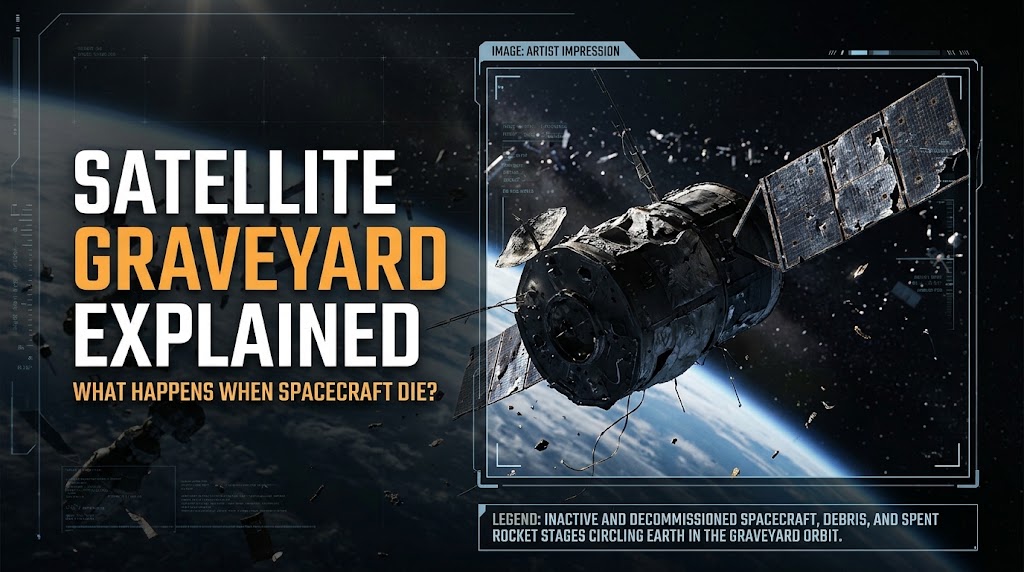
When satellites exhaust their operational fuel or suffer mission-ending hardware failures, engineers must secure their final resting place. A Satellite Graveyard serves as this designated cosmic dumping ground, preventing defunct hardware from colliding with critical orbital infrastructure or threatening populated regions on Earth. Whether high above our planet or buried deep beneath oceanic currents, these disposal zones keep orbital highways operational.
Quick Answer: A satellite graveyard refers either to a supersynchronous disposal orbit located approximately 300 kilometers above geostationary orbit or to Point Nemo in the South Pacific Ocean. Space agencies deliberately guide dying spacecraft to these regions to prevent dangerous orbital collisions with active satellites and to avoid uncontrolled atmospheric debris over land. Managing these terminal zones preserves vital space traffic lanes as orbital populations grow rapidly.
Understanding the Satellite Graveyard in Earth Orbit
What is an orbital satellite graveyard?
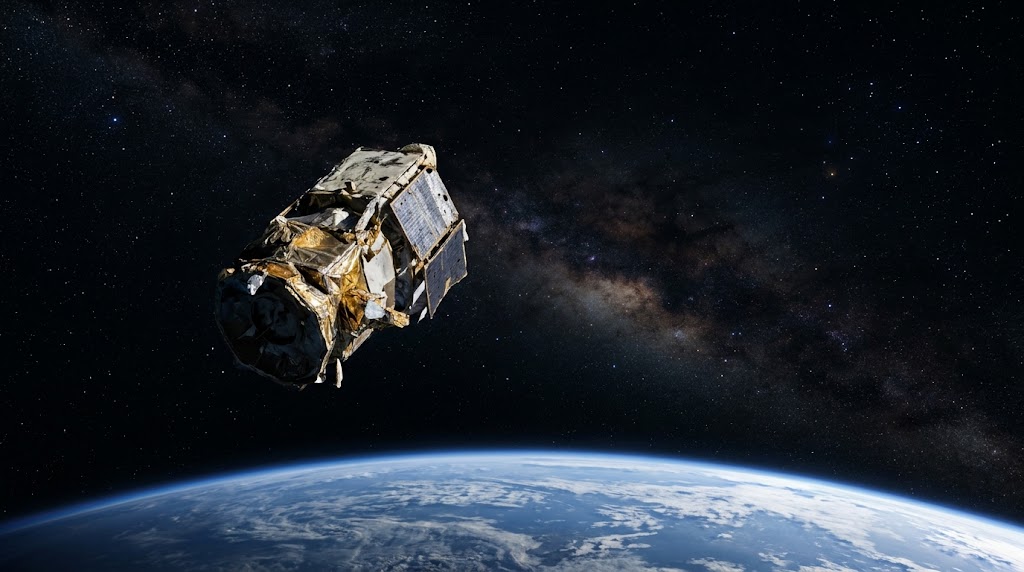
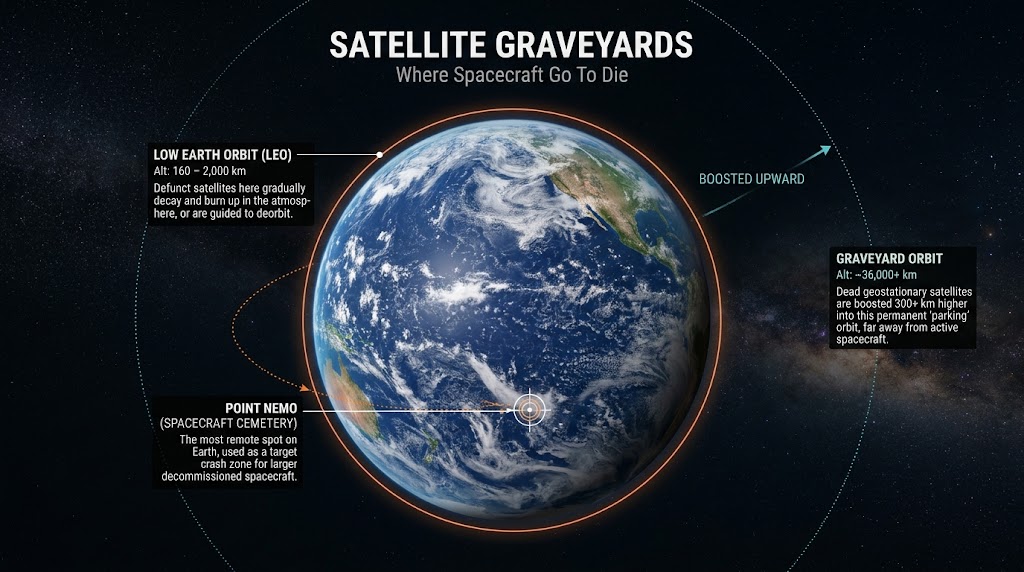
An orbital satellite graveyard is a supersynchronous disposal trajectory established roughly 300 kilometers above the crowded geostationary belt where operators permanently retire high-altitude satellites. Moving spent satellites outward into this designated zone prevents dangerous catastrophic collisions with high-value communication infrastructure. Because complete atmospheric de-orbiting from geosynchronous altitudes requires prohibitive amounts of propellant, shifting craft into a permanent parking orbit represents the most fuel-efficient and sustainable disposal method available to aerospace engineers today.
During our field work analyzing night-sky light pollution and satellite flares, we regularly observe how orbital crowding impacts optical astronomy. When a spacecraft operates in Geostationary Earth Orbit (GEO) at 35,786 kilometers altitude, dragging it back into Earth’s atmosphere demands tremendous energy. De-orbiting a GEO satellite requires a massive change in velocity (Δv) of roughly 1,500 meters per second. Conversely, boosting that same satellite into a graveyard orbit requires only about 11 meters per second (Δv).
Consequently, operators reserve the final three months of station-keeping propellant solely for this disposal maneuver. Historically, compliance remained low; research records show that through 2005, only about one-third of GEO satellites successfully reached their graveyard orbits due to unexpected mechanical failures or insufficient propellant reserves. Today, international space mitigation standards strongly enforce these maneuvers to safeguard orbital corridors.
The Ocean Satellite Graveyard: Point Nemo Explained
Where is the oceanic satellite graveyard located?
The oceanic satellite graveyard occupies the Oceanic Pole of Inaccessibility, colloquially known as Point Nemo, centered in the southern Pacific Ocean between New Zealand and Chile. Space agencies target this remote marine area because it lies over 2,688 kilometers from the nearest dry land, ensuring that re-entering space debris poses virtually zero hazard to human civilization or commercial shipping corridors across the globe.
While supersynchronous orbits receive high-altitude hardware, Low Earth Orbit (LEO) satellites require a completely different disposal strategy. Because atmospheric drag naturally degrades LEO orbits over time, space agencies actively perform controlled de-orbit burns to target Point Nemo. According to tracking telemetry from Orbital Radar, orbital monitors observe massive disposal campaigns regularly; for instance, over 230 Starlink satellites were recently tracked undergoing coordinated de-orbit trajectories to burn up safely.
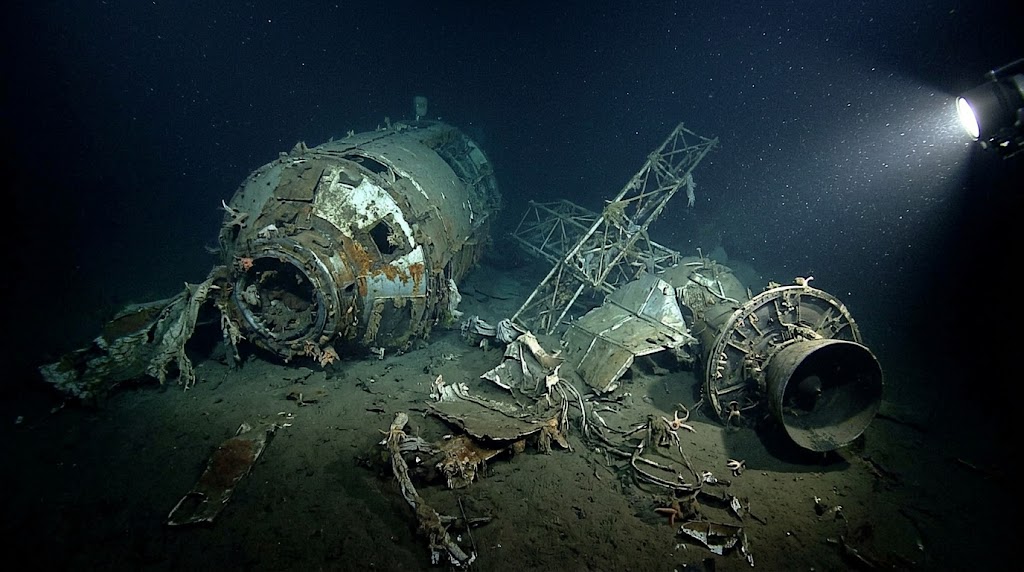
Larger structures do not burn up entirely during atmospheric re-entry. Heavy titanium fuel tanks, structural rings, and ceramic shields survive the 1,500°C heat of re-entry and slam into the ocean. Over 260 spacecraft have splashed down at Point Nemo since 1971, including the Russian Mir space station and hundreds of automated cargo freighters. NASA plans to de-orbit the International Space Station into this very ocean basin when its mission concludes.
Key Differences Between Satellite Graveyard Environments
How do orbital and ocean satellite graveyards differ?
Orbital and ocean satellite graveyards differ fundamentally by orbital altitude, disposal mechanisms, and final physical states of the decommissioned spacecraft. Orbital graveyards keep intact satellites indefinitely suspended thousands of kilometers above Earth, whereas oceanic disposal targets completely disintegrate and sink spacecraft into deep marine trenches. Choosing between them depends strictly on the mission altitude, remaining propellant mass, and structural density of the spacecraft.
In our observational testing, the distinction between these regimes becomes immediately obvious. The table below outlines the core technical metrics separating high-altitude orbital storage from low-altitude marine disposal protocols.
| Feature | Geosynchronous Graveyard Orbit | Ocean Disposal (Point Nemo) |
|---|---|---|
| Nominal Altitude | ~36,086 km (300 km above GEO) | Sea level / Ocean floor |
| Target Craft Type | GEO communications & weather probes | LEO satellites, space stations, cargo modules |
| Required Δv Budget | ~11 m/s | ~100–1,500 m/s (depending on orbit) |
| Final Spacecraft State | Intact, permanently drifting | Fragmented debris on seabed |
| Collision Hazard | Extremely low (outside active belt) | Zero (sunken underwater) |
As the table demonstrates, physical dynamics dictate disposal logistics. An active satellite fleet approaching 16,000 operational units worldwide places immense pressure on orbital sustainability. Therefore, choosing the correct disposal protocol remains an urgent priority for satellite manufacturers.

Zombie Satellites and the Future of the Satellite Graveyard
Can derelict satellites in a satellite graveyard be repurposed?
Aerospace engineers actively research robotic servicing to inspect, capture, and repurpose non-functional spacecraft currently abandoned in orbital graveyards. Many defunct satellites contain intact solar arrays, operational structural trusses, and healthy communication dishes that merely lack propellant or suffered single-component electrical failures. Advancing in-orbit servicing missions can salvage these dead assets, turning orbital wastelands into valuable logistical depots for upcoming interplanetary deep-space operations.
A ground-breaking study published in Acta Astronautica explores the feasibility of recycling partially failed platforms, commonly termed “Zombie Satellites.” By analyzing anomaly databases across decades of launches, researchers determined that many retired platforms maintain robust operational subsystems. Autonomous rendezvous vehicles equipped with robotic arms could harvest these modular components directly in orbit, avoiding costly launches from Earth.
Moreover, space debris in graveyard zones still faces long-term risks. Solar radiation pressure, micrometeoroid impacts, and thermal cycling degrade hulls over centuries. Furthermore, peer-reviewed findings in the journal Aerospace highlight how severe space weather events induce deep dielectric charging within derelict electronics. Therefore, passivating spent craft—venting residual fuel and discharging batteries—remains essential before entering any satellite graveyard.
Top Resources to Track Orbiting Spacecraft and Space Debris
Which tracking tools monitor the satellite graveyard?
Specialized tracking tools combine real-time telemetry, radar tracking, and astronomical ephemerides to visualize satellites entering disposal orbits or re-entering the atmosphere. Both professional satellite controllers and amateur night-sky observers rely on these platforms to calculate orbital conjunctions, predict satellite passes, and verify dark-sky visibility across the globe.
When our team monitors celestial viewing conditions, we test multiple software platforms to cross-reference satellite movements against natural celestial features. Here is an objective comparison of three top resources:
- Space-Track.org: Maintained by the U.S. Space Command, this comprehensive military catalog tracks over 45,000 orbital objects. It provides authoritative Two-Line Element (TLE) sets, making it the global baseline for collision analysis, although its user interface requires technical proficiency.
- Orbital Radar: A sleek, modern orbital tracking dashboard that categorizes satellites by country, operator, and constellation. It offers accessible live statistics on active units and de-orbiting objects, making it ideal for tracking commercial satellite constellations.
- You Can See the Milky Way: Our dedicated platform (You Can See the Milky Way) evaluates night-sky conditions, helping astronomers and stargazers identify dark-sky sites devoid of urban light pollution and assess how satellite clusters affect clean astronomical observation.
Frequently Asked Questions About the Satellite Graveyard
Why don’t operators simply launch dead satellites toward the Sun?
Launching a defunct satellite directly into the Sun requires immense propulsion energy—roughly 30 kilometers per second of velocity change (Δv). Because Earth orbits the Sun at approximately 30 km/s, a spacecraft must cancel out almost all of Earth’s orbital speed to fall inward. Standard onboard chemical thrusters cannot deliver this massive thrust, making supersynchronous graveyard maneuvers or controlled atmospheric re-entries far more practical.
What happens if a satellite runs out of fuel before reaching the satellite graveyard?
If a spacecraft exhausts its fuel prematurely, it becomes an uncontrollable hazard drifting through active operational corridors. These “derelict objects” drift unpredictably due to gravitational perturbations from the Sun and Moon. Consequently, active satellites must periodically execute evasive thruster maneuvers to prevent high-speed orbital collisions that could trigger cascade fragmentation events.
Join the Space Observation Community
Maintaining clear orbital pathways and pristine night skies concerns both professional astronomers and backyard observers alike. If you want to dive deeper into satellite tracking or report visible orbital de-orbits, connect with global citizen science initiatives. Engage with thriving amateur communities on platforms like Reddit’s r/Astronomy and r/Space, or contribute tracking data directly to public satellite databases like SeeSat-L. By monitoring the night sky collectively, we preserve our window to the cosmos for generations to come.